Nanomedicine is a relatively new and fast-growing area that makes use of nanotechnology in disease diagnosis, therapy, and surveillance on a molecular scale. In general, a wide range of nanomaterials can be employed within the scope of nanomedicine, but there is an increasing number of studies on the use of carbon dots (CDs). CDs are very small carbon particles with sizes below 10 nm that demonstrate high fluorescence, water solubility, stability, and biocompatibility.
In contrast to the traditional semiconductor quantum dots, carbon dots do not contain any harmful heavy metals and are ecologically safe materials. Their surface includes different groups of atoms, including hydroxyl, carboxyl, and amino groups, making the surface easy to modify to satisfy certain requirements of particular biomedical applications. Thus, CDs are considered to be one of the most promising nanomaterials in nanomedicine.
Main Characteristics of Carbon Dots
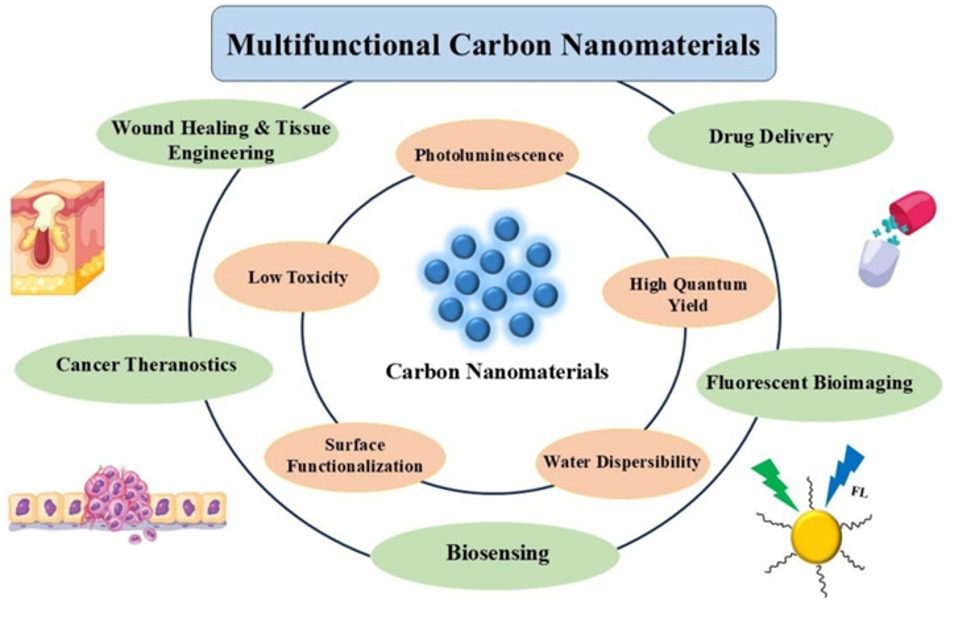
The increasing popularity of carbon dots results from the following characteristics:
- Excellent optical properties: The high brightness and tunability of the CDs’ photoluminescence allow their use in imaging.
- High stability: CDs are resistant to photobleaching.
- Nanodimension: Nanodimensions make it easy for CDs to penetrate biological systems.
- High biocompatibility: Being non-toxic substances, CDs differ favourably from metal nanoparticles.
- High surface area: CDs allow for efficient conjugation with drugs, ligands, or biomolecules.
- High solubility: CDs have a hydrophilic surface and good water solubility.
Methods for the Preparation of Carbon Dots
Carbon dots can be prepared by following either of two methods:
Top-Down Method
Larger carbon structures such as graphite, carbon nanotubes or carbon fibers can be reduced to nanoparticles of carbon using techniques such as laser ablation, chemical oxidation and electrochemical method.
Bottom-Up Method
Carbon dots can be made from molecular building blocks such as citric acid, glucose, amino acids, etc. using hydrothermal or microwave techniques. This method is very popular due to its simple procedure and low cost.
Significance of Carbon Dots in Nanomedicine
Carbon dots have received increasing attention in recent years due to their multifunctionality and various applications in the biomedical field. One of their important applications includes bio-imaging, wherein their enhanced fluorescence plays an integral role in cellular, tumor, organ, and biomolecular fluorescent labeling.
Owing to the negligible level of toxicity associated with carbon dots, they are considered safer fluorescent alternatives to other fluorescent labels used currently. Moreover, another application involves their use in drug delivery systems. The ability of carbon dots to functionalize facilitates their capability to attach drugs to their surface or encapsulate them in their interior, thus resulting in efficient and safer delivery of drugs to target sites.
For instance, anticancer drugs could be delivered specifically to cancerous cells, whereas antibiotics could be delivered effectively to the infected site. They also offer the advantage of having extremely small sizes that enable them to penetrate tissue barriers easily. Furthermore, their applications can extend to theranostics, wherein imaging of diseased sites and delivering therapeutic agents to these locations could be achieved simultaneously.
In addition, carbon dots have excellent antimicrobial activities through membrane damage, production of ROS, and interference with metabolic processes in microbes, thus becoming potential antimicrobial agents that target bacteria which have resistance to antibiotics. In cancer treatments, the use of carbon dots in targeting cancer cells and delivering anti-cancer drugs is extensively investigated. In some situations, they are able to kill cancer cells using photothermal and photodynamic approaches under light irradiation.
Functionalization of Carbon Dots
One of the main benefits of carbon dots is their capacity to easily functionalize. Functionalization enhances the performance of carbon dots by increasing the effectiveness and specificity when used in medicine. The process involves:
- Attaching targeting ligands (antibodies and peptides)
- Conjugating drugs
- Encapsulating polymers for stability
- Linking biomolecules for biosensing
Functionalized carbon dots selectively target diseased cells without harming healthy tissue.
Applications in Healthcare
Carbon dots are being explored in several medical fields:
- Imaging and treatment of cancer
- Disease detection biosensors
- Neurodegenerative disease studies
- Medical device antibacterial coatings
- Gene/drug delivery methods
- Cellular imaging
Their versatility makes them suitable for both research and clinical applications.
Advantages of Carbon Dots in Nanomedicine
There are numerous strengths that carbon dots have over traditional nanomaterials:
- Low levels of toxicity
- Biocompatibility
- Cost-effective synthesis
- Environmental friendliness
- Excellent stability
- Superior fluorescence quantum yield
- Multi-functional properties (diagnostics + treatment)
- Simple surface functionalization for targeted drug delivery.
Challenges and Limitations
Although carbon dots have many potentials, there are some obstacles that must be overcome.
- An inadequate understanding of toxicity in humans in the long term
- Trouble with producing them on a larger scale
- Having different properties based on how they were produced
- Lack of clinical tests and regulations
Overcoming these limitations is important for clinical applications.
Future Perspectives
The future looks very promising for carbon dots in nanomedicine. Researchers are working toward making them more targeted, stable, and effective. Within the next few years, the potential uses of carbon dots could include:
- Personalized medicine
- Smart drug delivery systems
- Disease monitoring in real-time
- Nanomedicine for cancer treatment/diagnosis
- Bio-sensors
As advancements keep taking place in the field of nanotechnology and biomedical engineering, there will come a day when carbon dots become an essential part of healthcare technology.
Conclusion
Carbon dots can be considered an innovative category of nanomaterials in the field of nanomedicine because of their special optical characteristics, biocompatibility, and versatility. The possibility of integrating all these features into a single nanoparticle allows them to be very useful in the context of current medical practice. Despite the need for further development in terms of their practical implementation in the clinic and safety studies, their application prospects in the field of personalized medicine and therapy are undeniable.
Currently, our research hub is also working on carbon dots and their applications in nanomedicine for future therapeutic and diagnostic advancements.