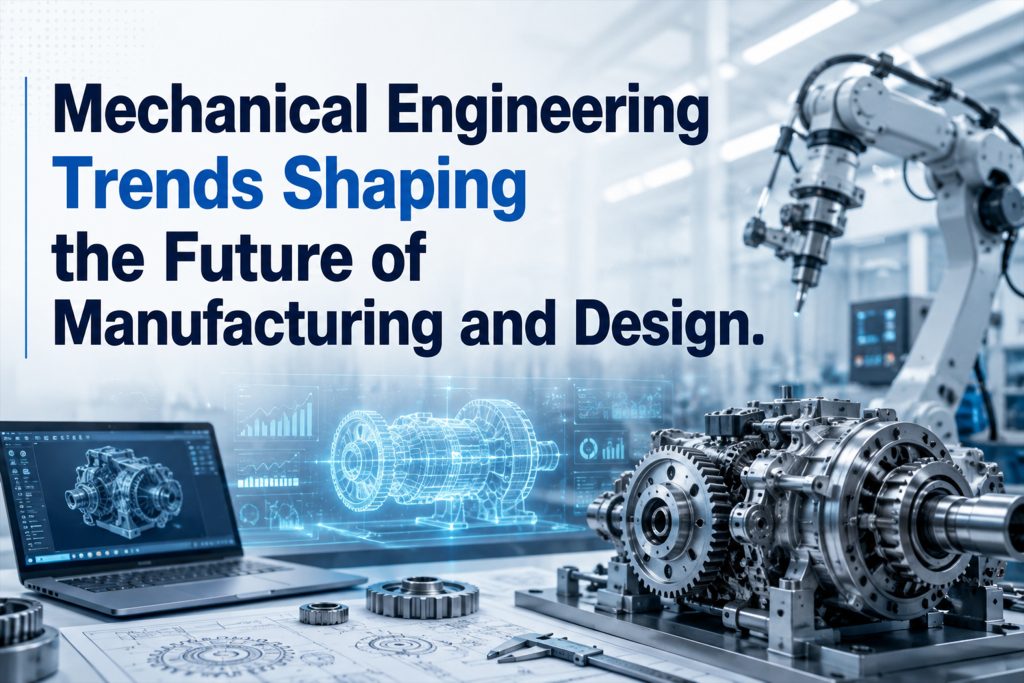
Mechanical Engineering Trends Shaping the Future of Manufacturing and Design

Digital twin technology

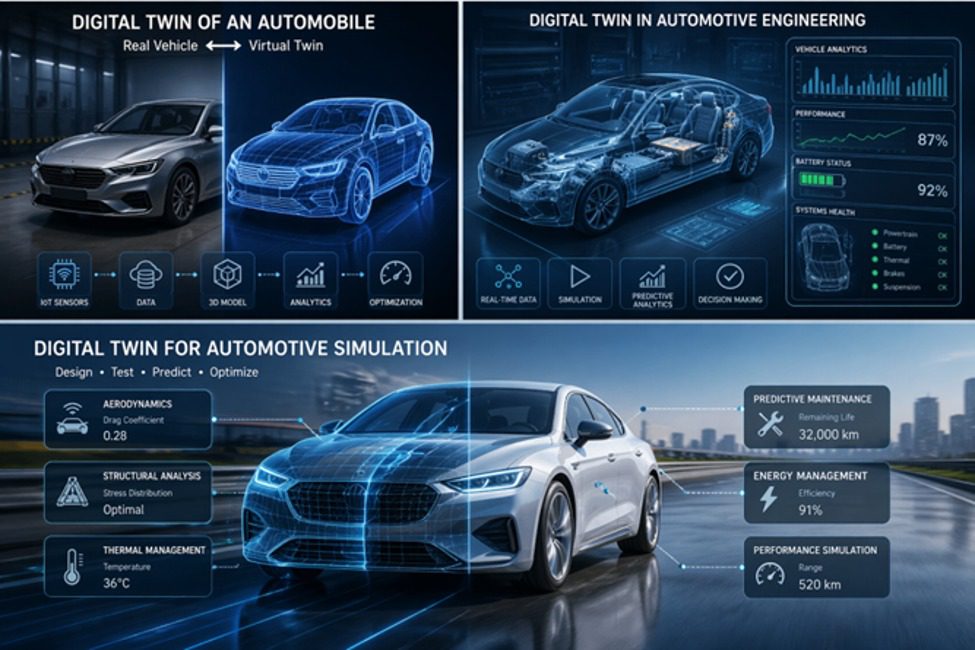
Technology of Digital Twin involves creation of virtual models for a real-life object or a process which will mirror the actions in the virtual environment. The sensors will feed information through the AI algorithms, thus creating a real-time environment. Digital Twin will provide companies with the ability to conduct scenarios, improve and optimize the performance of any process involved.
Key Components and Functionality

Real-time Data SynchronizationDigital twins are linked to their physical counterparts via IoT sensors, enabling them to mirror their current state, including changes in environment and operation.

Simulation & Analysis engineers can simulate decisions and analyze performance without risking the actual physical asset.

Lifecycle Management covering the full lifecycle from design and development to production and maintenance.

Key Applications

Manufacturing for process optimization and waste reduction of materials, predictive maintenance.

Smart Cities: Urban planners simulate traffic flows and energy consumption.

Healthcare: Creates virtual organ models for custom treatment strategies and outcome forecasts.

Automotive & Aerospace: for Formula 1 and aircraft engine design and testing.

Generative Design

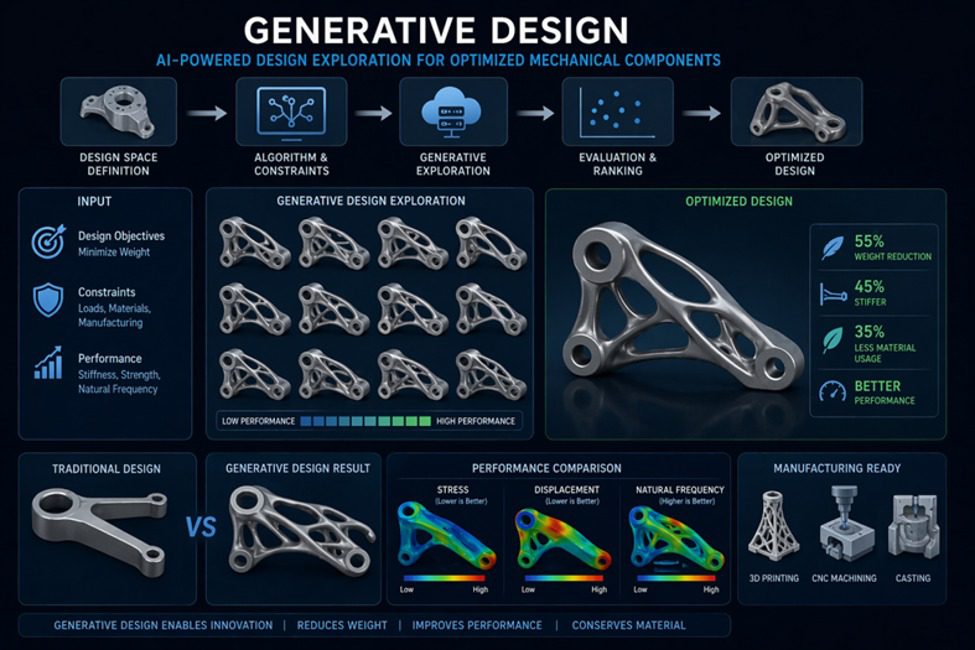
Generative design refers to a process involving artificial intelligence where designers input goals and limitations in the form of materials used, methods of production, and cost budgets for the software to come up with multiple design options. The technique makes use of machine learning algorithms to analyze huge design spaces and develop intricate lightweight designs that would be difficult to imagine manually.
Key Aspects of Generative Design:

The Process: Instead of a human drawing a model like with traditional CAD ,generative design starts by defining parameters , constraints , and goals . The AI then generates solutions based on those.

Optimization: The software evaluates alternatives on performance, weight reduction and cost and allows designers to select the most promising options.

Applications: This material is used a lot in manufacturing to make parts. It is also used in the industry to make components lighter. People in architecture like to use it because it helps them make the most of the space they have and create sustainable designs. They use it to make buildings that’re good for the environment and that use space in a smart way, which is really important, for sustainable designs and space-optimized designs.

Manufacturing Constraints: The software looks at how things are made like using a 3D printer or a milling machine to make sure the design can really be made. It checks the production methods, such, as 3D printing to see if the design is possible to manufacture. The software wants to know if the design can be made using these production methods, like milling so it checks them carefully.

Smart Materials & Manufacturing

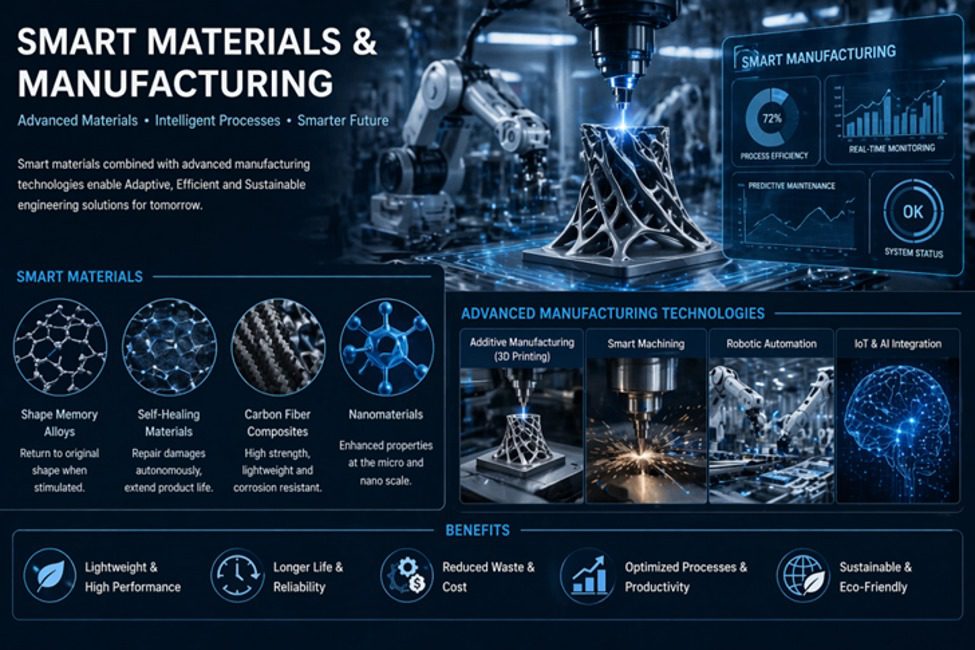
Smart materials are kinds of materials that can change or react to things around them like temperature, light, pressure or stress all on their own. They do not need anyone to control them. Shape-memory alloys and self-healing polymers are examples of these materials. They help make things more efficient, able to fix themselves and last longer. When we combine these materials with a special way of making things called additive manufacturing we get something called 4D printing.

4D printing lets us make parts that can adapt and work well in areas, such, as

  • Aerospace
  • Medicine
  • Construction

These areas use materials to make new and better products. Smart materials and 4D printing are changing how we make things. They help make products that can fix themselves and work better. Smart materials are used in areas. They make things more efficient and long-lasting. The use of materials and 4D printing will keep growing. It will help make new and exciting products.
Key Types of Smart Materials:

Shape Memory Alloys (SMAs): Metals, such as Nickel-Titanium alloys have a property. They can change shape. Then return to their original shape when heated. This is really useful. These metals, like Ni-Ti alloys can be bent or stretched. Then go back, to their original shape when exposed to heat. The Ni-Ti alloys are an example of such metals. They are often used in applications. These applications take advantage of the properties of Ni-Ti alloys.

Self-Healing Materials: There are substances that can fix damage on their own using containers called microcapsules that have special helpers, inside them called healing agents. These microcapsules have healing agents that make the substances able to repair damage. The substances use these microcapsules with healing agents to fix damage.

Piezoelectric Materials: Materials that turn stress into electrical energy and also turn electrical energy into mechanical stress are often used in things, like actuators and sensors. These materials are special because they can change stress into electrical energy. They are used in devices. Actuators and sensors are examples of these devices. They help convert energy from one form to another. These materials make it possible. Piezoelectric materials are an example. They are used often.

Chromic Materials: Materials that change color with light are called photochromic. They change color when exposed to light. Materials that change color, with heat are called thermo chromic. They change color when heated or cooled.

Magneto-rheological Materials: There are substances that change how thick or thin they are when they are, near a field. These substances are really cool because they can become thicker or thinner when a magnetic field is turned on or off. Magnets can actually make these substances change their viscosity.

Additive Manufacturing Technology

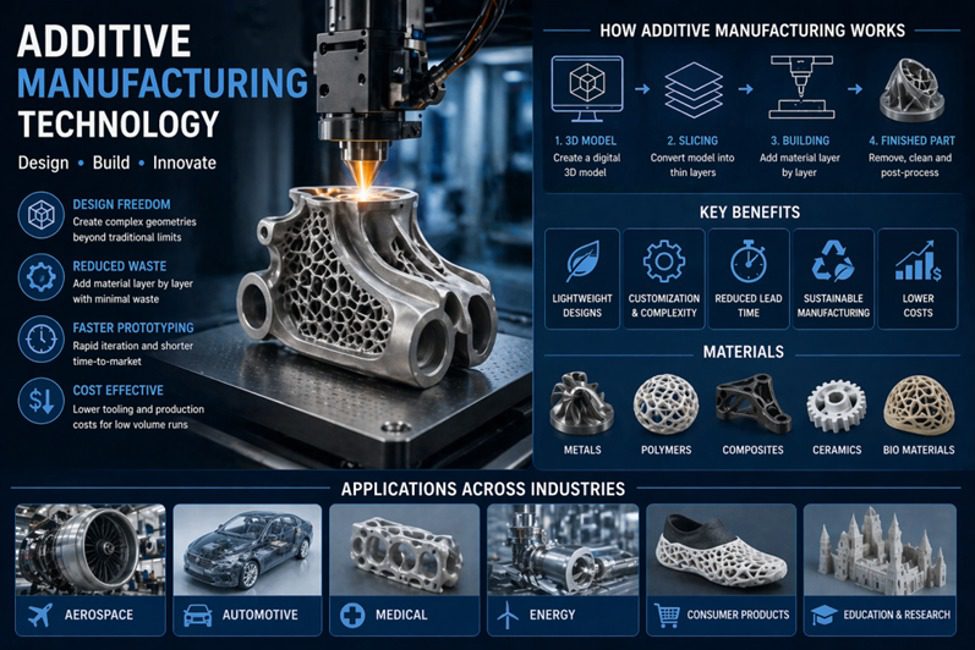
3D printing is one of the growing areas of mechanical engineering. It is changing the way we design, make prototypes and manufacture things. Normally we make things by cutting away at a block of material. 3D printing is different. It builds things layer by layer.

This way of doing things lets us be more flexible with our designs, waste material and make things more efficiently. This helps us come up with engineering solutions. Recently people have been working on making 3D printing better and stronger. They are also trying to incorporate intelligence into the design process, print with many materials at once and use 3D printing for big industrial projects.

Some of the trends in 3D printing include using advanced metals, composites and 3D printing for medical use like 3D bio printing.
Applications

Aerospace: The company makes things that’re lightweight, they have complex shapes and they are really good, at what they do these are high-performance components.

Automotive: Prototyping, tooling and customized parts production. We make prototypes quickly. We also make tools. We produce parts that are customized.

Medical: The doctor will use things that are made for the patient. These things can be implants or prosthetics or even special tools that the doctor will use during surgery. The patient will get implants that are made for them. The doctor will also use prosthetics that are made for the patient.. The doctor will have special surgical tools that are made just for the patient. The patient will get the care because the doctor is using patient-specific implants and prosthetics and surgical tools.

Energy Sector: We need components that can resist corrosion. We also need good solutions to repair critical systems. These critical systems are very important. We have to make sure they keep working properly. We have to find components that can resist corrosion so that our critical systems do not get damaged.


Leave a Comment

Your email address will not be published. Required fields are marked *

Scroll to Top

Download Brochure

Group Head: Dr. S. VAIDEVI, M.Tech., Ph.D

Professional Brief

Academic Profile

M.Tech, PSG College of Technology, Coimbatore/Anna University, Chennai.
Ph.D Biotechnology, Anna University, Chennai.

Professional Experience

Rathinam Technical Campus
Associate Professor in Biotechnology: Dec 2021 – Till date

Research Intrest:

  • Drug delivery
  • Cancer therapeutics

Teaching:

BE/B.Tech (Information Technology/Computer science/Electricals and
Electronics/Artificial Intelligence and data science) (Physics)

Sponsored Research Project

S.No Title Funding Agency Grant Amount Duration Institute Status
1.
Development and evaluation of bevacizumab nanodispersion for effective treatment of lung cancer
Department of Health Research, ICMR, Govt of India
46 Lakhs
Nov 2022 to Nov 2025
Department of Biomedical Engineering, Rathinam Technical Campus (Mentor: Dr. B. Nagaraj, Principal –Rathinam Technical Campus)
Ongoing
2.
Ruxolitinib loaded carbon dots for bioimaging and treatment of lung infections Collaborator: Dr. Anindita Chakraborty, Kolkata center
UGC- Department of Atomic Energy (DAE),CSR, Kolkata
1.35L
Nov 2023
Rathinam Technical Campus, Coimbatore
Sanctioned
3.
Resveratrol- Quercetin dual drug loaded nanoparticulate system: A versatile approach to treat colorectal cancer
ICMR Senior Research Fellow Project
15 Lakhs
June 2018 to June 2021
Department of pharmaceutical technology, Anna University Tiruchirappalli (Mentor : Dr. K. Ruckmani Professor)
Completed

Team Members:

Dr. J. KUMAR, M.Tech., Ph.D

Academic Profile

M.Tech, Bannari Amman Institute of Technology, Coimbatore/Anna University, Chennai.
Ph.D, Biotechnology, Anna University, Chennai.

Professional Experience

Rathinam Technical Campus
Associate Professor in Biotechnology: 2022 March – Till date

Research Intrest:

  • Drug delivery
  • Cancer therapeutics
  • Rheumatoid arthritis treatment

Sponsored Research Project

S.No Title Funding Agency Grant Amount Duration Institute Status
1.
Development of New Combinational Strategy of Methotrexate and Minocycline: A Novel Lipid-based Drug Delivery System for the Effective Management of Rheumatoid Arthritis
ICMR Senior Research Fellow Project
15 Lakhs
June 2018 to June 2021
Department of pharmaceutica l technology, Anna University Tiruchirappalli
Completed

Dr Bradha Madhavan
Head – Functional Materials for Energy Applications

Professional Brief

Academic Profile

  • PhD- Materials Science, Anna University Chennai, PSG Institute of Advanced Studies,
    Coimbatore.
  • M.Phil – Physics, Manonmaniam Sundaranar University, Tirunelveli.
  • M.Sc – Physics, S. T. Hindu College, Nagercoil, Manonmaniam Sundaranar University,
    Tirunelveli.
  • B.Sc – Physics, Sree Ayappa College for Women, Nagercoil, Manonmaniam Sundaranar
    University,Tirunelveli.

Professional Experience

  1. 2020 Dec- till date- Working as Associate Professor at Rathinam Technical Campus,
    Coimbatore.
  2. 2018-2020- Worked as Assistant Professor in Sri Krishna College of Engineering and
    Technology, Coimbatore, India. (Department of Physics)
  3. Post-doctoral researcher: CSIR-National Institute for Interdisciplinary Science and
    Technology, Trivandrum from (18-4-2016 -18-4-2018)
  4. November 2012 – April 2015: Worked as a project fellow at PSG Institute of Advanced
    Studies, Coimbatore – 641004, under the project Proton and oxide ion conduction in
    LaTiO3 doped perovskites funded by UGC-DAE CSR, India.
  5. July 2011– November 2012: Worked as Assistant Professor in Kalaivani College of
    Technology, Coimbatore, India. (Department of Physics)
  6. July 2008 – May 2011: Worked as Lecturer in SSK College of Engineering & Technology,
    Coimbatore, India.(Department of Physics)
  7. December 2005 – April 2007: Worked as Lecturer in Francis Xavier Engineering College,
    Tirunelveli, India. (Department of Physics)

Honors, Awards and Grants:

  • Awarded National Post-Doctoral Fellowship, Science & Engineering Research
    Board (SERB), Government of India – 2016
  • Project Fellow UGC-DAE-CSR, Government of India (2012-2015)
  • Received travel fellowship grants from DST and CICS (2015)

Research Intrest:

  • Metal oxides for energy applications such as (SOFC), PEM fuel cells, Sensors, Gas
    separation membranes, super capacitors
  • Perovskite materials for High temperature superconductors and super capacitors
  • Advanced functional energy materials for high-temperature applications
  • Metal oxides for photocatalytic applications

Teaching:

BE/B.Tech (Information Technology/Computer science/Electricals and
Electronics/Artificial Intelligence and data science) (Physics)

Funded Projects:

S.No Title Funding Agency Grant Amount Role Status
1.
Development of novel efficient La(1- x)SrxMn(1-y)By O3-δ (B= Mg, Co ) one dimensional perovskite cathode material for low temperature solid oxide fuel cell
BRNS
20L
PI
On-going
2.
Development of Pd diffused transition metal (Mo, Co, W) based chalcogenic heterostructures support on carbon nanostructures/Ni foam for electrochemical water splitting
Aeronautical Research and Development Board (AR&DB)
36 L
Co-Principal Investigator
Ongoing
3.
Neutron diffraction, magnetism and dielectric studies of LaTi 0.5 B 0.5 O 3-δ (B= Mn, Co, Fe)
UGC-DAE Mumbai -Node
1.45 L
Principal Investigator
Ongoing
4.
Development of novel nano perovskite oxide materials
International Centre for Diffraction Data
1000 USD
Principal Investigator
On-Going

Team Members:

1. Mr. S. Prakash, M.Sc., Research Scholar, BRNS project
2. Mr. C. Shatheesh, M.Sc., Research Scholar, UGC-DAE project

Group Head: Dr. K. K. Aruna

Professional Brief

Academic Profile

  • M.Sc Physics, St. Paul’s College, Kerala
  • M.Phil Nanoscience and Technology, PSG Institute of Advanced Studies, Coimbatore,
    Tamilnadu
  • Ph.D Nanoscience and Technology (Interdisciplinary Physics), PSG Institute of Advanced
    Studies, Coimbatore, Tamilnadu

Professional Experience

Rathinam Technical Campus
Associate Professor in Physics: 2020 – Till date
Sri Krishna College of Engineering and Technology
Assistant Professor: 2018 – 2020

Honors, Awards and Grants:

  1. Indian National Science Academy’s Visiting Scientist Fellowship, 2023, for a project entitled “Development of novel anodic electrocatalysts for urea-assisted waste water splitting for efficient and green hydrogen production”.
  2. Short-term Research Stay Grant from the University of Bayreuth, Germany Centre of International Excellence “Alexander Von Humboldt”, 2022, for a project entitled “Synthesis and Characterization of Iridium-Decorated Titanium Oxynitride Supported on Nanocarbon (Ir/TiON@NCF) for Water splitting”.
  3. DST Indo-Mexican sponsored research visit to CINVESTAV-IPN, Unidad Saltillo- Monterrey, MEXICO, 2015, for a project entitled “Development of Non-Platinum Based Catalyst for Acid and Alkaline Fuel Cells.

Research Intrest:

  • Electrochemical Water Splitting
  • Fuel cells
  • Batteries
  • Supercapacitors

Teaching:

BE/B.Tech (Information Technology/Computer science/Electricals and Electronics/Artificial
Intelligence and data science) (Physics)

Sponsored Research Project:

S.No Title Funding Agency Grant Amount Role Status
1.
Development of Pd Diffused Transition Metal (Mo, Co, W) Based Chalcogenic Heterostructures Support on Carbon Nanostructures/Ni Foam for Electrochemical Water Splitting Collaborator: Prof. Dr. Prakash Chandra Ghosh, Indian Institute of Technology, Bombay
Aeronautical Research and Development Board (AR&DB)
35.86 L
Principal Investigator
Ongoing
2.
Bifunctional Ternary ThioSpinel Nano forms@Carbon Nanostructures for Sustainable Energy Applications, Collaborator: Indira Gandhi Centre for Atomic Research, Kalapakkam Node, Tamilnadu
UGC-Department of Atomic Energy (DAE), Kalpakkam
1.35 L
Principal Investigator
Ongoing
3.
Design, Development and Integration of Hydrogen Based Energy Storage and Conversion System for Underwater Applications PI: Dr. Muthukumar Palanisamy, Indian Institute of Technology, Tirupathi
IIT Guwahati Technology Innovation and Development Foundation
30 L
Co-Investigator
Ongoing
4.
Development of novel efficient La (1-x) Sr x Mn (1- y) B y O 3-δ (B= Mg, Co ) one-dimensional perovskite cathode material for low temperature solid oxide fuel cell
Board of Research for Nuclear Sciences
20 L
Co-Investigator
On-Going
5.
Decision Support Tool for Climate Risk Management in Manufacturing Industries
Coalition for Disaster Resilient Infrastructure (CDRI)
7.3 L
Mentor
Completed

Team Members:

1. Mr. Thangaraj. A, Junior Research Fellow, M.Sc Physics
2. Ms. Aishwarya, Project Assistant, M.Sc Nanoscience and Technology

Alumni:

1. Mr. Akash, Junior Research Fellow, M.Tech Nanoscience and Technology
Currently doing Ph.D at Gyongsang National University, South Korea
2. Mr. Rahees, Junior Research Fellow, M.Sc Nanoscience and Technology
Currently doing a Ph.D at the Institute of Hydrogen Research, Quebec, Canada